At the Jaramogi Oginga Odinga University of Science and Technology (JOOUST), an innovative hatchery is revolutionizing fish farming. This project has not only solved a major challenge for local farmers but has also created a thriving ecosystem for education, commerce, and community empowerment—all centered on the sustainable use of insects.
The journey began with a persistent problem: fish farmers throughout the region struggled to find a consistent supply of high-quality fingerlings. To address this, JOOUST established a modified hatchery. However, as demand grew, the university hit a critical bottleneck. A severe shortage of holding tanks for broodstock (the fish that provide eggs and fingerlings) and the high cost of conventional fish feed made it difficult to scale the enterprise.
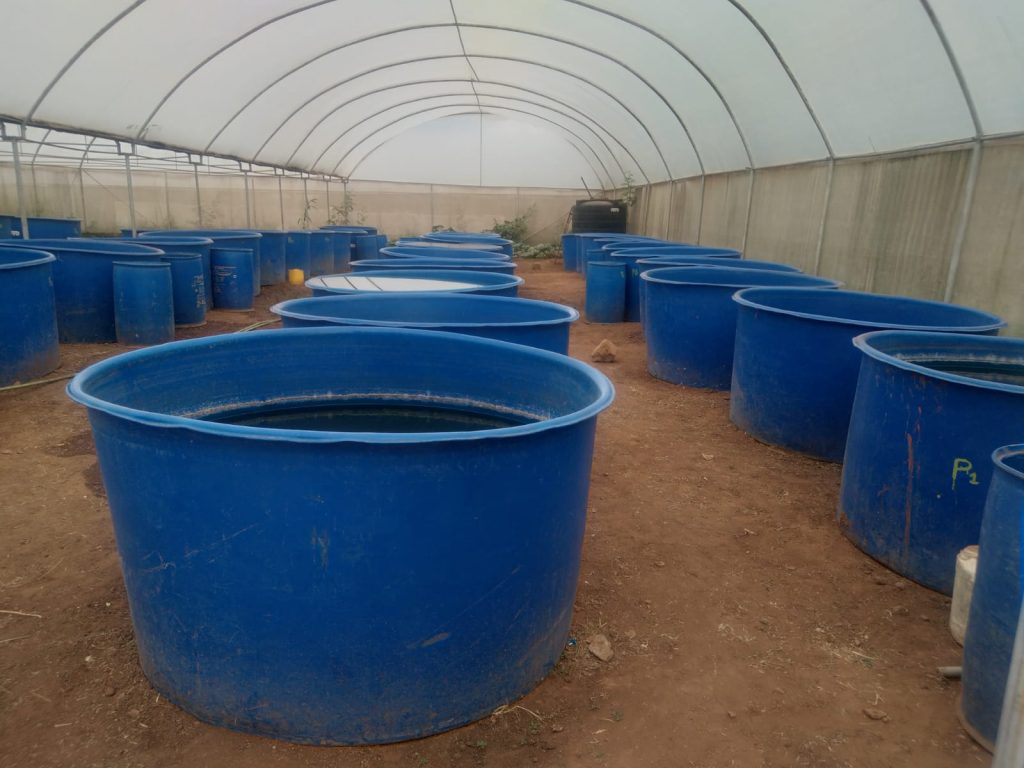
This is where the World Bank supported Africa Centre of Excellence in Sustainable Use of Insects as Food and Feeds (INSEFOODS) stepped in. Recognizing the potential of insects for sustainable food systems, the Centre offered crucial support. The hatchery was already formulating its fish feed using Black Soldier Fly (BSF) larvae —a highly nutritious and environmentally friendly protein source. To unlock the hatchery’s full potential, INSEFOODS funded the purchase of 30 new holding tanks.
This targeted investment was the catalyst that transformed a promising pilot into a commercially viable operation. With the new tanks, the hatchery has dramatically increased its production capacity, ensuring a steady supply of top-tier fingerlings for both commercial and community use.
Today, the hatchery operates as a commercial venture, selling high-quality fingerlings and generating much-needed revenue for the university. This self-sustaining model demonstrates a clear pathway for academic projects to contribute to institutional growth.
The project also directly benefits local communities. Fish farmers now have a trusted, local source for quality fingerlings, helping them improve their fish stocks and enhance their livelihoods.
A living laboratory for future scientists
Beyond its commercial success, the hatchery has become a vibrant living laboratory. Postgraduate students conduct their research on-site, gaining invaluable practical experience in sustainable aquaculture. The facility has also hosted students from other Centers of Excellence on exchange programs, fostering a collaborative network and promoting knowledge-sharing across the continent. This hands-on, real-world experience is preparing the next generation of leaders to drive innovation in sustainable food production.