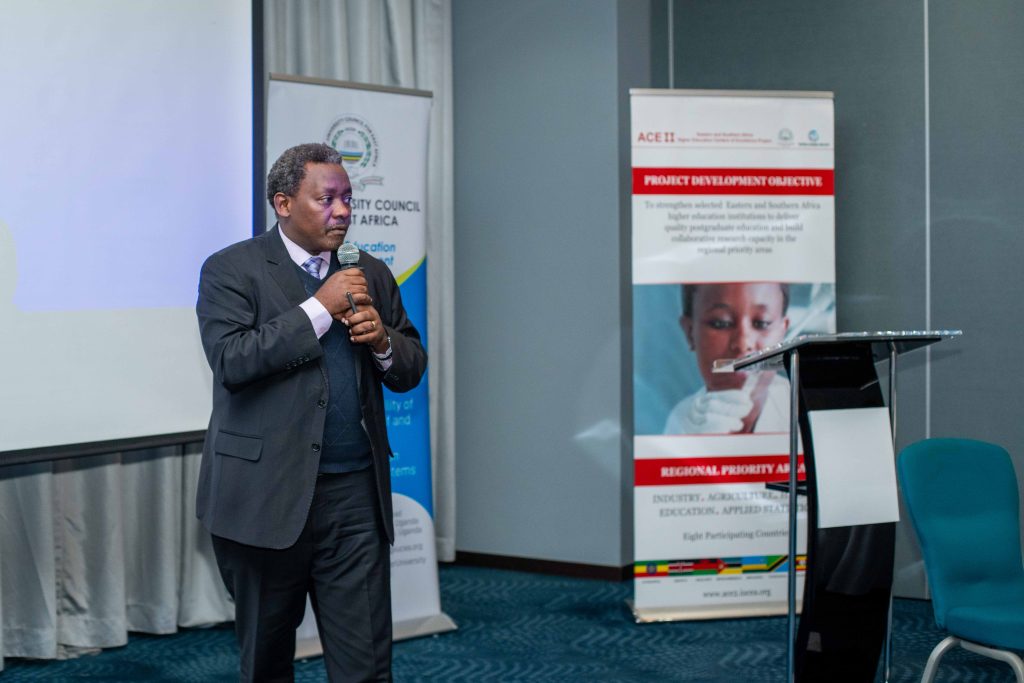
OPENING REMARKS BY THE EXECUTIVE SECRETARY OF THE INTER-UNIVERSITY COUNCIL FOR EAST AFRICA (IUCEA) AT THE LEADERSHIP TRAINING PROGRAMME FOR VICE CHANCELLORS AND CENTRE LEADERS
Vice Chancellors, Deputy Vice Chancellors, Rectors,
Center Leaders here present
The Chairperson of the ACE II Regional Steering Committee
The Representative of the World Bank – joining us online,
Respected Facilitators and Mentors,
Dr Jude Ssewubufu, Project Coordinator and your team at RFU
Colleagues from IUCEA Secretariat
Ladies and Gentlemen,
A very good morning to you all.
It is with great pride, deep conviction, and a shared sense of urgency that I stand before you today to officially open the Leadership Training Programme for Vice Chancellors and Centre Leaders, convened by the Inter-University Council for East Africa (IUCEA) in partnership with the World Bank under the ACE II Project.
This is not just another training but rather a call to action. A gathering of transformative leaders at a defining moment for higher education in East and Southern Africa and indeed, for the entire African continent.
Ladies and gentlemen,
We meet at a time when the promise of excellence through our Centres of Excellence remains an unfinished journey. We have made significant progress. The ACE II project has established and strengthened 29 Centres across 18 universities in 8 countries. So far, we have trained almost 10,000 postgraduate students, with 1,852 PhD and 7,616 Master’s students. We have also produced close to 5,000 research publications in globally recognized journals, with 4,229 published to date. Our centers have generated over $47.5 million in external revenue and have upgraded academic staff qualifications. Furthermore, 39 academic programs have been internationally accredited, primarily through leading European agencies.
But we all know: this is only the beginning. The road to world-class, development-oriented universities in Africa is long. It demands more than infrastructure, publications and curricula. It demands visionary leadership, leaders who can align academic excellence with national priorities, turn research into solutions, and mobilize resources, political will, and public trust.
That is why you are here today. Each of you is not merely an administrator; you are a catalyst for the next phase of Africa’s higher education transformation.
Ladies and gentlemen,
The road to world-class, development-oriented universities in Africa is long. It demands more than infrastructure and curricula. It demands visionary leadership, leaders who can align academic excellence with national priorities, who can turn research into solutions, and who can mobilize resources, political will, and public trust.
That is why you are here today. Each of you in this room: Vice Chancellors, Rectors, Centres Leaders, etc. is not merely an administrator. You are change agents. You are influencers. You are strategic leaders with the power to shape policy, shift budgets, and inspire nations.
Therefore, today I speak to you as catalysts for the next phase of Africa’s higher education transformation.
Ladies and gentlemen,
Let us be honest with ourselves. Despite our achievements, Africa still faces a crisis of relevance in higher education. Too many graduates lack the skills for today’s job market. Too many universities remain disconnected from industry and community needs. Too much talent migrates abroad because the ecosystem at home does not nurture innovation.
The Centres of Excellence model, pioneered through ACE I in West Africa and advanced under ACE II in East and Southern Africa, has shown us a path forward. These centres have become beacons of specialized training, research excellence, and regional collaboration. They have proven that African universities can compete globally when given the right support. But the journey remains far from complete.
We need more centres. We need deeper regional integration. We need sustainable funding models. And above all, we need leadership that dares to think beyond survival—to think in terms of legacy and impact.
Ladies and gentlemen
I am pleased to inform you, may be you already know that the World Bank, recognizing the urgency of skills development and employment, has just launched a new regional initiative under the Multiphase Programmatic Approach (MPA). This initiative focussing on skills for jobs is expected to include a transformative component known as “ACE Futures”, a bold vision to scale up and sustain Centres of Excellence across the continent.
This is a once-in-a-decade opportunity to institutionalize excellence, expand access to high-quality STEM, digital, and green economy education, and directly link universities to job creation. However, this opportunity will not realize itself. It will require political will. It will require national ownership and it will require you, our university leaders, to step forward as champions.
I know the power you hold. I know the access you have to Ministers, Presidents, and Cabinet offices. I know the respect you command in your countries.
And so, I make a direct appeal to each of you:
- Go back home and secure a firm commitment from your government to support this new World Bank initiative.
- Advocate for your nation to be at the table when ACE Futures is designed and funded.
- Position your university not as a beneficiary, but as a leader in shaping the future of skills and innovation in Africa.
If we miss this moment, we risk another decade of underinvestment, missed opportunities, and brain drain. If we act now, with unity, vision, and courage, we can unlock billions in new resources for higher education across East and Southern Africa, and beyond.
Ladies and gentlemen
This training for this week is all about transformation beyond theory.
You are here because you are among the most influential leaders in African higher education. You lead institutions that educate the next generation of engineers, doctors, data scientists, entrepreneurs, and policymakers.
And the challenges you face are immense:
- How do we lead in the age of artificial intelligence?
- How do we finance excellence without relying solely on public budgets?
- How do we ensure our universities are inclusive, innovative, and accountable?
That is why this programme, building on the success of our first Leadership Training in Zanzibar last July 2025, has been designed with three strategic pillars:
- Strategic Leadership & Institutional Transformation – How to lead change in complex environments, drive innovation, and align your university with national and regional development goals.
- Research, Innovation & Industry Linkages – How to turn research into impact, foster entrepreneurship, and build partnerships that generate revenue and jobs.
- Governance, Advocacy & Regional Integration – How to lead with integrity, influence policy, and position your institution as a key player in our regions and the broader African Continental Education Strategy.
You will have an opportunity to engage with some of Africa’s most distinguished academic leaders, visionaries like Prof. Olive Mugenda, Prof. Celestino Obua, Prof. Silas Lwakabamba, Prof. Tim Waema, Dr. Angela Ndunge, Prof Mshono and others who have not only led institutions but transformed them.
You will engage in peer-to-peer learning, case studies, and mentorship sessions. We do believe that the best solutions often come from shared struggles and collective wisdom. And above all, you will build a regional network of excellence, a community of leaders who continue to support, challenge, and inspire one another long after this week ends.
Ladies and Gentlemen,
The future of Africa will be written in our universities. It will be shaped by the decisions we make today about leadership, about investment, about relevance. We cannot afford to wait. We cannot afford to be incremental. We must be bold, united, and forward-looking.
Let us not be the generation that saw the opportunity but hesitated. Let us be the generation that seized the moment, that expanded the ACE model, that bridged the skills gap, that built universities worthy of Africa’s aspirations.
Indeed, this is the Africa we envision in Agenda 2063, a continent driven by knowledge, innovation, and self-reliance; an Africa where education empowers its people, where youth are creators of wealth, and where universities are engines of transformation. This training is also about fulfilling the promise of Agenda 2063.
To the World Bank, the TTL, DR Roberta and your team, thank you for your continued trust and investment in our regions. Your support for ACE II has been transformative. We look forward to deepening our partnership under this new initiative.
To the Government of Kenya, thank you for hosting us in this vibrant hub of innovation and regional leadership.
To my IUCEA team and to our facilitators, your dedication makes this possible.
And to each of you: feel welcome. This is your moment. The continent is watching. The future is calling.
With these words, it is my distinct honor and privilege to officially declare open the Leadership Training Programme for Vice Chancellors and Centre Leaders, Nairobi 2025.
Asanteni sana. Karibu Nairobi.
Prof Gaspard Banyankimbona