By Jean Niyitegeka
To modernise agriculture and reduce crop losses caused by birds, five PhD students from the University of Rwanda (UR), through the African Centre of Excellence in Internet of Things (ACEIoT), have developed AudioMoth, a solar-powered and AI-integrated smart device designed to scare pest birds off farmlands.
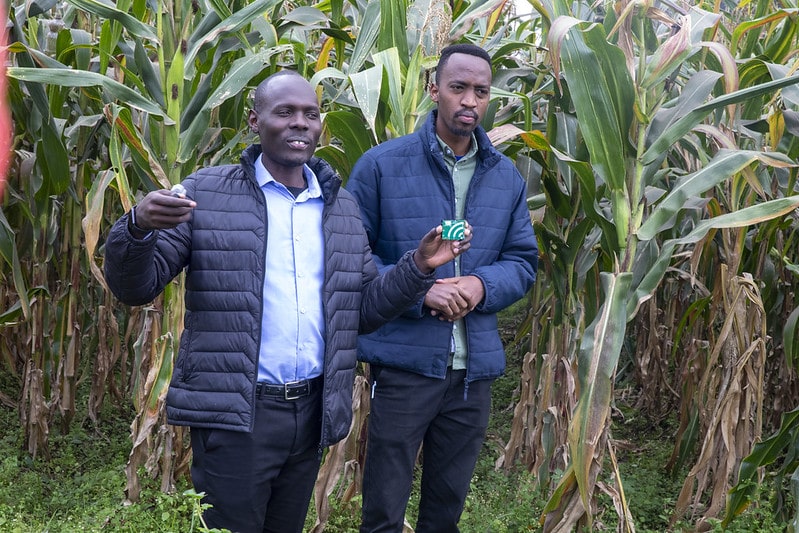
The prototype which has been under development for three years, was showcased at a workshop at the University of Rwanda’s College of Agriculture, Forestry and Food Sciences (CAFF) in Busogo Sector, Musanze District in July.
The workshop aimed to raise awareness about the Smart Pest Bird Scaring System for Small-scale Farmers, featuring AudioMoth as a prototype. The technology is part of the project titled “Acoustic Data from Agriculture Monitoring (ADAM),” implemented by the ACEIoT in collaboration with the Rochester Institute of Technology (RIT) and Carnegie Mellon University.
How does AudioMoth work?
AudioMoth is designed to monitor bird sounds and activities in the crop farm using Internet of Things (IoT) sensors and machine learning models. It captures bird sounds through a microphone on either Nano BLE sense or XIAO ESP32S3 sense and identifies specific bird species using a TinyML (Tiny Machine Learning) model.
If pest birds are detected, the device triggers loud deterrent sounds via a connected speaker to chase them away.
On the crop field, this solar-powered device is elevated slightly above the ground to be able to accurately capture the sounds and can protect up to one hectare of the farmland. For larger fields, multiple devices can be installed.
The device setup is made up of an SD card for data storage, a microphone, a solar panel, and a speaker. It has a waterproof case, and is made with Global System for Mobile Communications (GSM) and Global Positioning System (GPS) technologies for location tracking, keeping the farmer’s information, and easy communication, allowing the farmer to monitor its functionality and effectiveness.
Importantly, farmers do not need to own smartphones to interact with the system. The device sends SMS alerts in case of malfunction, failure to scare birds, or if it is moved or stolen, allowing rural farmers with basic phones to be able to use it.
“We have trained our AI model to recognise sounds from seven common pest-bird species in Rwanda,” explained Samson Ooko, a second-year Phd student involved in the project.
“The system also rotates deterrent sounds to prevent birds from adapting or getting used to similar sounds. If the birds persist, the farmer is alerted instantly.”
Farmers praise the innovation
The workshop was not only to present the device and its technology benefits for farmers, but also to gather feedback from local farmers and feedback, which would be used to improve the prototype before implementation and scaling.
Dorothée Uwababyeyi, a farmer from Kabaya Village in Gisesero Cell, described the project as “a solution we’ve long waited for.”
“For the other pests, we have pesticides. But with birds, we’re left helpless. Sometimes our children miss school to chase them off. If this technology is scaled, it will undoubtedly revolutionise our harvest,” she said.