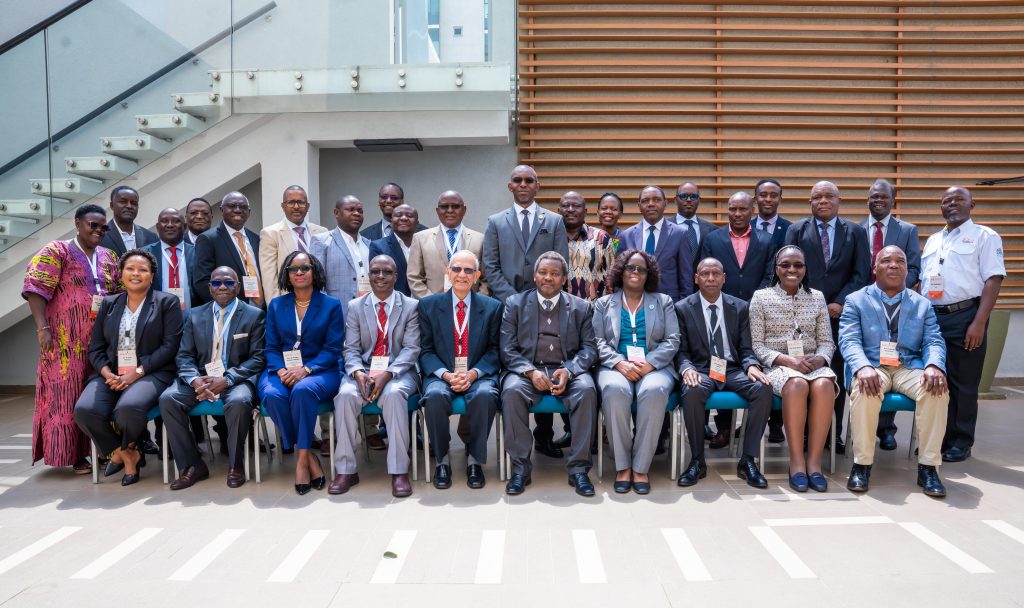
The Eastern and Southern Africa Higher Education Centers of Excellence (ACE II) Project has launched its leadership and management training for Vice Chancellors in Nairobi, Kenya. This World Bank-supported project creates a crucial platform where leaders will tackle the complex challenges of modern education leadership, from navigating rapid technological changes to driving innovation across universities.
At the opening ceremony, Prof. Gaspard Banyankimbona, then Executive Secretary of the Inter-University Council for East Africa (IUCEA), challenged the assembled leaders:
“You are not merely administrators. You are change agents. You are influencers. You are strategic leaders with the power to shape policy, shift budgets, and inspire nations. Today I speak to you as catalysts for the next phase of Africa’s higher education transformation.” See full remarks here.
Prof. Goolam Mohamedbhai, Chairperson of the Regional Steering Committee for the ACE II project, attributed the program’s success to strong leadership and collaborative consultation.
“The governance structure of the project ensures consultation among all stakeholders – quite unique in Africa,” Prof. Goolam explained. “The commitment of all actors – the ACEs, universities, ministries, the Regional Facilitation Unit [IUCEA], the Regional Steering Committee [RSC], the National Steering Committees [NSCs], and the World Bank – made this possible. Everyone played their role fully, especially in providing necessary leadership.” See full remarks here.
He emphasized that challenges were overcome through “wise leadership and consultation,” identifying leadership, consultation, and commitment as the three defining elements of the ACE II Project’s success.
The training explored how Vice Chancellors can lead university-industry partnerships and establish incubation hubs. These hubs transform knowledge into practical solutions that drive economic growth. Universities now face the challenge of creating spaces that stimulate new enterprises and innovations while enhancing graduate employability and contributing to local development.
Prof. Celestino Obua, former Vice Chancellor of Mbarara University of Science and Technology, shared key insights about these innovation spaces:
“Incubation hubs cannot follow typical organizational setups run by well-established policies. Instead, they operate through a culture that motivates and inspires everyone to approach challenges differently for new outcomes. It’s not one size fits all,” he said.
By providing Vice Chancellors from the ESA region with essential tools and strategies for adaptation and growth, this training program contributes to shaping the future of academic leadership across Africa.